![An image showing the definition of an array: int test[10]. The array type is int, the name of the array is test, and its size is 10.](images/array_def.png) |
![An image showing how to access one element in the array named test: test[5].](images/array_el.png) |
| (a) | (b) |
- An array definition.
- An array is a variable, so when programmers create or define an array, the definition must have the two parts required of any variable definition: (a) a data type and (b) a variable name.
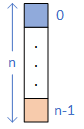
- Unlike simple, non-aggregate data, arrays also have a size or capacity - the number of elements in the array.
- When the compiler creates an array, it allocates a contiguous block of memory large enough to contain all the array elements without gaps or spaces.
- Once a programmer defines an array, its size is fixed and cannot change.
- Each array element is the same type as the array itself.
- A single array element.
- The individual array elements are accessed by an index (also known as a subscript).
- Index values follow the array name and appear between a pair of opening and closing square brackets, forming the index operator.
- Programmers can "index into an array" with a constant, a variable, or an integer-valued expression.
- The index value must be greater than or equal to zero and less than the array size.